Carbon Fibres for Brain-Machine Interfaces
Overview
Conventional intracortical electrodes — silicon shanks and metal microwires — suffer from a chronic foreign-body response that degrades recording quality over time. Glial scarring around stiff probes can exceed 100 µm in thickness, progressively silencing nearby neurons. Carbon fibre microelectrodes, with individual diameters of ~7 µm and mechanical stiffness close to that of brain tissue, minimise this mismatch. This project develops and characterises carbon fibre electrode platforms for cortical recording, neurochemical sensing, and neural stimulation, in collaboration with Carbon Cybernetics and RMIT University.
The Carbon Cybernetics Array
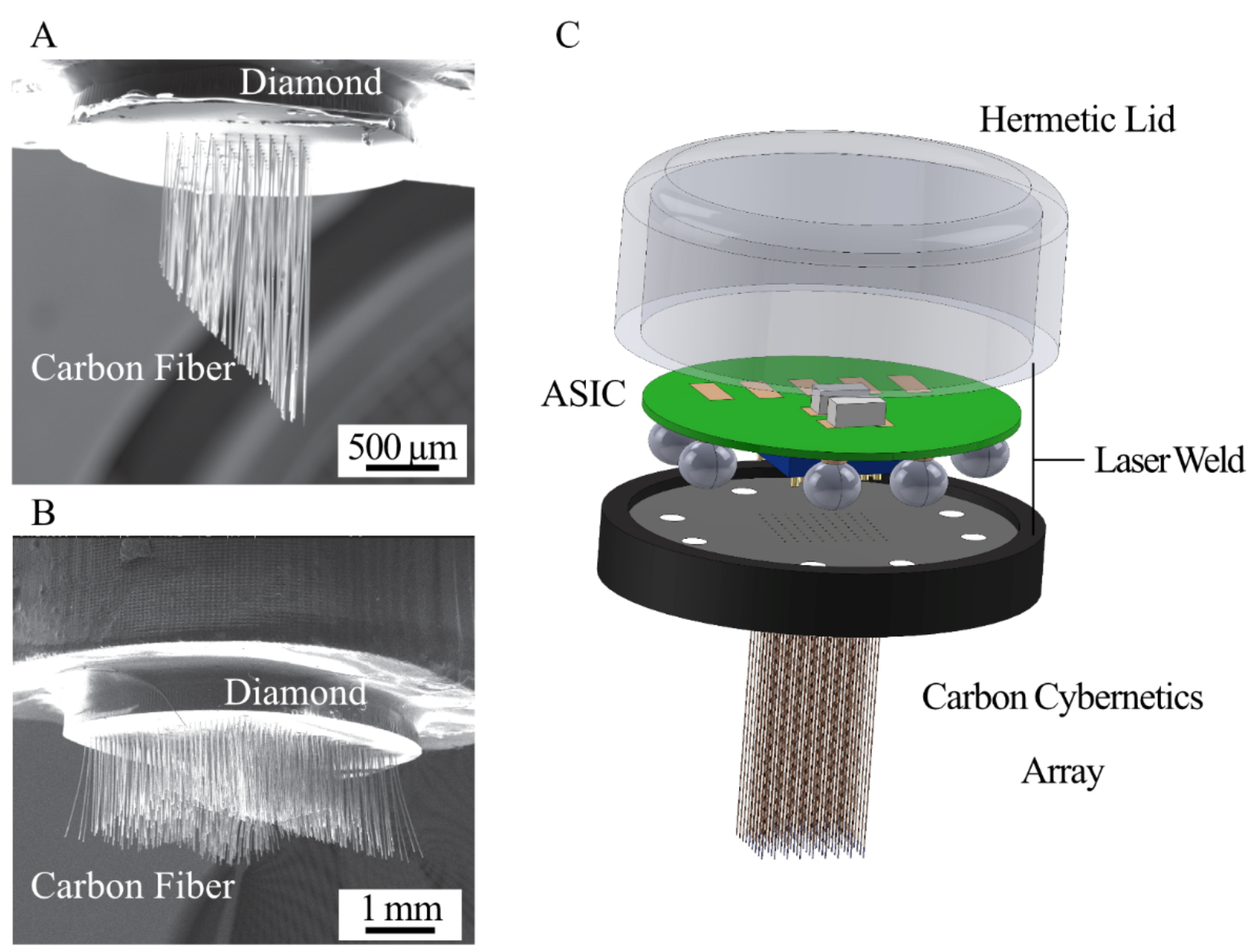
The Carbon Cybernetics Array is a miniaturised, hermetically sealed microelectrode array built on a 2.5 mm diamond substrate, with individual carbon fibres brazed via gold active-alloy bonding — replacing the silver paste and PCB substrates used in earlier designs. Diamond's impermeability enables hermeticity validation by helium leak testing (detection limit 10⁻¹¹ mbar L/s), a critical step toward fully implantable wireless devices.
Arrays implanted chronically in rat cortex for up to 6 months produced glial scar thicknesses of under 20 µm, compared to over 100 µm for conventional probes. Single-unit recordings have been obtained in both rats and sheep, and the platform has been scaled to 25, 100, and 1024 channels.
MXene-Doped PEDOT Coatings
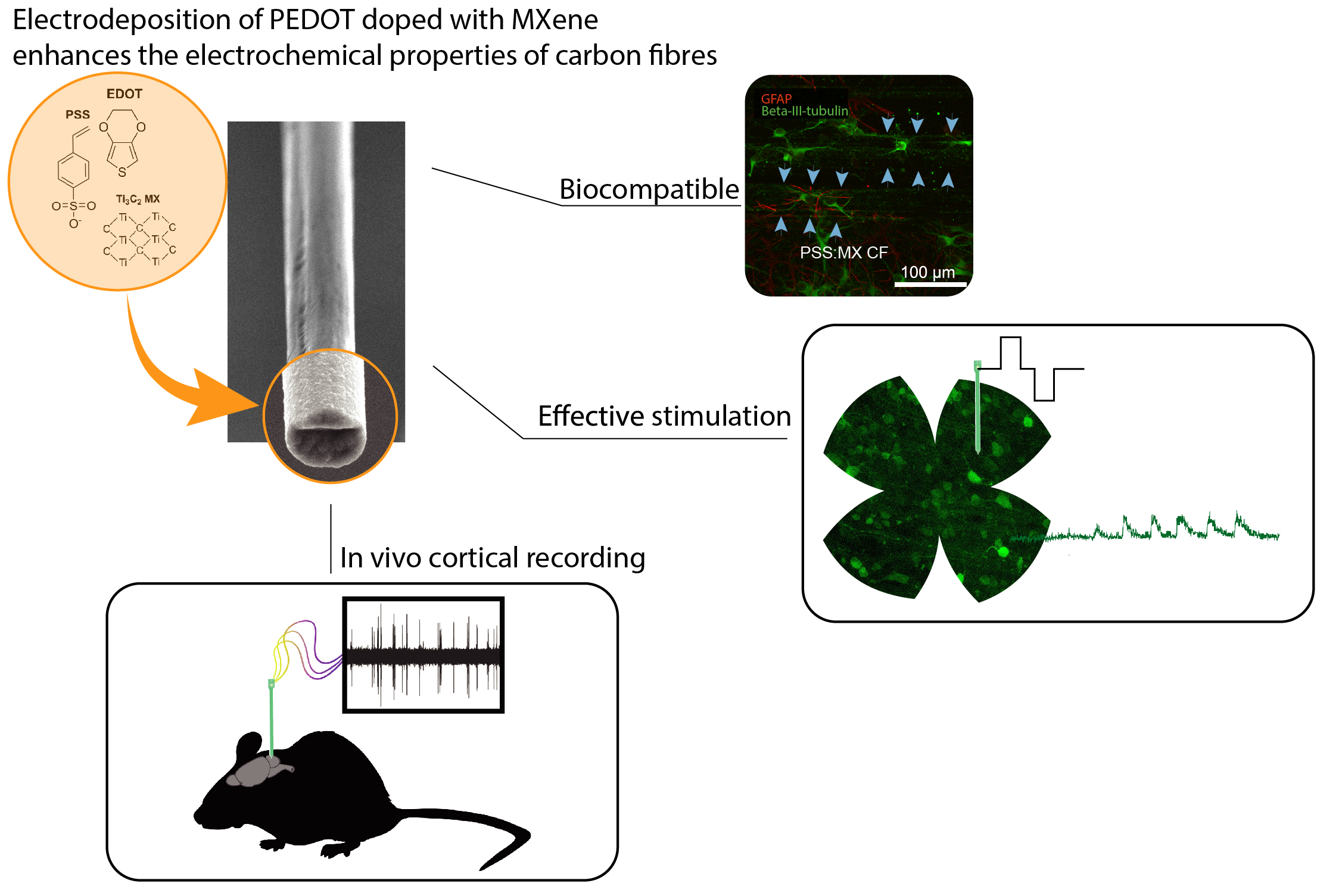
Bare carbon fibres exhibit high impedance (~493 kΩ at 1 kHz) and limited charge injection capacity, restricting their use for stimulation. To address this, MXene (Ti₃C₂Tₓ) was introduced as a counter-ion dopant during electrochemical PEDOT polymerisation directly onto the fibre surface — a method compatible with microwire geometries where spin-coating and ink-printing are impractical.
The resulting PEDOT:PSS:MX composite reduced impedance to 16 kΩ at 1 kHz and increased charge injection capacity from 0.15 to 4.7 mC/cm² — a greater than 30-fold improvement. Coated electrodes evoked calcium responses in retinal ganglion cells ex vivo and recorded single-unit spiking activity in rat visual cortex in vivo, demonstrating dual recording and stimulation capability. Primary cortical neurons and astrocytes confirmed biocompatibility of all coated surfaces.
Boron-Doped Nanocrystalline Diamond Coatings
For neurochemical sensing applications such as fast-scan cyclic voltammetry (FSCV) dopamine detection, uncoated carbon fibres fail over time due to biofouling and electrode etching under repeated high-voltage cycling. A boron-doped nanocrystalline diamond (B-NCD) coating, grown conformally by microwave plasma-enhanced CVD, adds only ~1 µm to the fibre diameter while providing exceptional electrochemical stability.
After 108 hours of simulated FSCV cycling, uncoated fibres were completely destroyed and PEDOT:Nafion-coated fibres showed bulk etching, while B-NCD fibres remained intact with no measurable degradation. Dopamine sensitivity was comparable across electrode types (LOD ~0.04 µM), and stimulation-evoked dopamine release was successfully detected in vivo in rat nucleus accumbens.
Related Publications
- De León SE, Jaylani R, Jung YJ, et al. Evaluating MXene-doped PEDOT coating on carbon fiber microelectrodes for dual-functional neural interfacing. Analytica Chimica Acta. 2026;1407:345509. https://doi.org/10.1016/j.aca.2026.345509
- Higham S, Jung YJ, De León SE, et al. Carbon Cybernetics Array: a miniaturized carbon-based microelectrode array for intracortical recording. bioRxiv. 2026. https://doi.org/10.64898/2026.01.06.696090
- Higham SJ, Rojas Cabrera JM, De León SE, et al. Boron-Doped Nano-Crystalline Coated Carbon Fibers for Phasic Dopamine Sensing. Advanced Healthcare Materials. 2025. https://doi.org/10.1002/adhm.202503945
- De León SE, Higham S, Jung YJ, Tong W, Garrett DJ. Recent developments in microwire-structured intracortical electrode arrays for brain–machine interfaces. Bioengineering & Translational Medicine. 2024;e10742. https://doi.org/10.1002/btm2.10742
Collaborators
Carbon Cybernetics · RMIT University — Biomedical Engineering · The University of Melbourne